A History of the Hudson Family: Part I
“A train came thundering by
Drawn by the snorting iron steed
Swifter than eagles fly.
Rumbled the wheels, the whistle shrieked,
Far rolled the smoky cloud,
Echoed the hills, the valleys shook,
The flying forests bowed”

Marshall Pass, Westside, along the Denver Railroad in Colorado, c. 1880-81. William Henry Jackson photograph
So begins the scene describing a locomotive ripping westward towards the young American territories in the 1884 short story “The Denver Express,” by popular American novelist Augustus Allen Hayes. The protagonist, Henry Sinclair, is described as one “tall, well-made man of about thirty – blond, blue-eyed, bearded, straight, sinewy, alert. Of all in the train, he seemed the most thoroughly at home”. He is traveling aboard the Denver Fast Express, through America’s dangerous frontier territories to the city of Denver at the heart of the region’s famous gold and silver mining booms.
Shortly before Hayes published his short story in the British magazine Belgravia, a mysterious man arrived in a small mining town in Colorado. Almost certainly having made the journey aboard a similar train, this man, who perhaps resembled our Henry Sinclair in physical appearance, was named James S. Hudson. Over the following years, he would increasingly demonstrate considerable means, authority, and connections as he established himself in the local mining community. But although James Hudson was quick to leave his mark in Colorado, and later wherever he resided up until his death, evidence of his life and origins before Colorado is virtually nonexistent. A ghost.
Just a few years earlier, President Ulysses S. Grant officially admitted Colorado as the 38th state in 1876. Colorado thus represented the American frontier as the 19th century drew to an end, and in the following decades the state epitomized the idea of the “Wild West” now known around the world. The mining booms drew adventurers from across the country, populating small frontier towns and filling their rowdy saloons. It was here where Butch Cassidy began his criminal escapades, and clashes with native tribes like the Utes left dead across the state.
In other words, a mysterious character like James seems a natural fit in the environment. What stands out is how quickly he demonstrates the activities of a shrewd and highly literate civic insider with extensive connections. While no known paper trail of his life exists prior to his time in Colorado, as soon as he does emerge, he quickly leaves a conspicuous footprint. Countless records over the next 15 years show James acted as notary for deeds and property deals across the state, in addition to his own transactions buying and selling rights to lands. He even teamed up with a well-off family from Boston in a successful lawsuit against a large mining company.
With Colorado’s chaotic silver boon reaching its zenith at this time, property and mining rights were almost a form of currency in itself. To act as an official notary for dozens of deals may therefore suggest someone with a strong education and a degree of authority that fosters trust across class lines in a community at a time when a large portion of the frontier population was likely unfamiliar with state and federal laws. It also allows one to imagine someone who knew how to develop an extensive network, ranging from wealthy capitalists buying up silver mines to the illiterate immigrants seeking homesteads and new lives.
So how is it that such a seemingly prolific character appears out of nowhere? All of the information that is available on James’ life, as well as the information that isn’t, further adds to the man’s intrigue. The dearth of primary sources paints only a vague portrait of his life. At the age of 55, his marriage certificate is the first document that offers any biographical clues. Together with a passport application submitted months later in 1896, they indicate that he was born on 24 October 1840 in Providence, Rhode Island, to Augustus A. Hudson and Henrietta Dana, both listed as born in England. The same details are given seven years later in 1903 on his Michigan death certificate 1, marking the end of his briefly documented life.

Indeed, for a man of his presumed societal stature, the lack of additional documents is conspicuous. The same is even more true for his parents, for whom not even single piece of evidence of their existence can be found, beyond the two aforementioned records that name them. The distinctiveness of both parents’ names makes it all the more puzzling that not one document for either of them can be found in England, the United States, or elsewhere. Given the abundance of nineteenth-century census, marriage, and other civil records now available, such a complete absence is striking. Within the wider Hudson family tree, James remained an exception as the sole (early) dead-end among most other lineages that could be traced back to the 17th century and earlier.
Nevertheless, the records that do exist offer a glimpse into an adventurous life. In 1895, James found himself in Nebraska where he married 25-year-old Carrie May Gilleland, 30 years his junior. It appears to have been a match of two wandering souls. Carrie, herself an audacious spirit, was born in Michigan to an England-born mother and an American father, descending directly from the illustrious Delano family. What brought this young woman to the “Wild West” remains unclear, though she would not stay long.
Within months, the couple applied for passports with the aim of reaching Brazil. Again, the new couple’s motivation for choosing such an unusual and arduous destination is unclear. By 1896, the country was a nascent and fragile republic, still in its democratic infancy just seven years after overthrowing the Emperor Dom Pedro II. In the midst of a violent war and political instability, the country was also experiencing rapid growth fueled largely by a global demand for coffee and Amazonian rubber. Foreign technology and experts poured in to support the new government’s economic plans. This meant the landscape was rife with economic opportunities for men like James. Many of these foreigners became involved in building new infrastructure projects, such as railway networks for transporting coffee, electrical grids, and telegraph lines, or as trade brokers and industrialists.
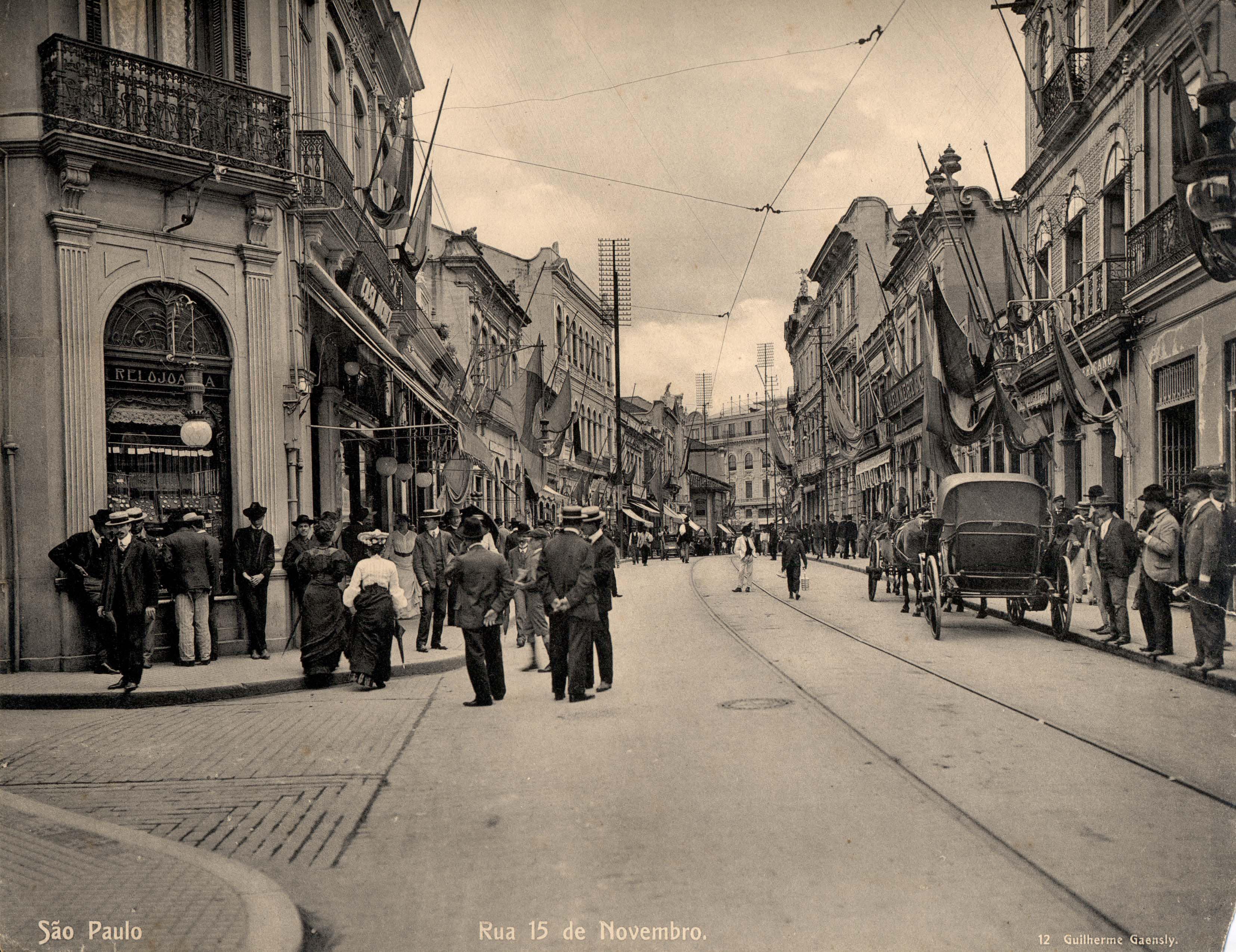
We may also take as a clue James’ listed occupation on his passport application: miner. Under the Brazilian Empire, which lasted until 1889, the subsoil and mining rights belonged strictly to the Brazilian crown. However, the new constitution of 1891 radically changed this, as mineral rights were passed to the surface landowners. This triggered a rush of speculators, domestic and foreign alike, scrambling to buy and sell land or negotiate mining concessions with the owners. For a man of James’ station and known experience, it’s plausible he was also drawn by such prospects.
On 18 October 1896, this brief chapter in Brazil became permanently etched into family history with the birth of their first son, Harold Dana Hudson, in São Paulo. Further record of the new family’s time in Brazil is yet to be found, but later census records indicate Harold “immigrated” to the United States with his family in 1898.
Their landing point was New York City, where the Hudsons settled and firmly planted the family into the American East Coast where they would remain until the pull of new horizons would again draw them west a half century later2. In 1899, Carrie May gave birth to their second son, Richard Delano Hudson3, as noted on the 1900 US Federal Census which listed James as the head of the family residing in Brooklyn.

This would be the last known official record of James before his death just three years later. In 1903, while in the small township of Pipestone, Michigan, likely visiting his wife's uncle George Sharp, James passes away from heart failure at age 62. He would be laid to rest nearby in Caldwell Cemetery in Eau Claire, where his wife would rejoin him 47 years later in 1950, but not first before their eldest son, Harold, would be buried beside his father after his death in 1924 at just 27 years old.


(Hyperlinks are added for sources and additional historical context for curious readers.)
- With exception of the fact that his birthday was listed as a day later on 25 October, a plausible mistake on the filer’s behalf. Though perhaps James remained a mystery even to those who knew him personally, as his middle name is also unverifiable, varying on documents as either Sampson or Sameson. In at least one newspaper clipping, he's named as James Spencer Hudson. ↩
- When James’ grandson, Richard Delano Hudson II, his wife Elizabeth, and two sons Richard III and David drove by car to move the family from Connecticut to California in 1954. ↩
- With Richard’s naming, the family revealed its penchant for honoring its heritage. “Delano” is in reference to Carrie May’s paternal grandmother, Weathea Delano, of the Delano family that arrived in Plymouth, Massachussetts in the mid 1600s from the Netherlands. Three generations of Hudson men would go on to take full name Richard Delano Hudson. Harold’s middle name of Dana can be linked to James’ listed mother, Henrietta Dana, though the lack of information about James and his roots gave uncertainty to the origins of this family line. ↩

Comments
Post a Comment